

The Story Behind “Brutal Light”
 It wasn’t until I looked back to the beginning, and saw the path I had taken–which had led me to a story and a world that felt mired in the weight of everything I was trying to cram into it–that I saw the path that would lead me out. It was a path that meant leaving everything I thought defined the story behind, save its core, and starting anew with a resolute focus on that core–a hard thing, given how many years I had been trying to make it work. But I took it… and at its end was what is now my debut novel, being published today–“Brutal Light”.
Identity, I’ve come to realize, has always been a central issue in my writing. There are so many ways we cling to words and the ideas behind them–and often, any ideas that seem attached to them, whether or not they should be–and, for so many, a terror at having these words and ideas ripped away. Who am I, underneath all the words I say define me, and am I really sure there’s any ‘me’ there?
On deciding to write my first novel, I drew on stories I wrote for Internet reader consumption in the nineties for inspiration, and wrote the draft at a blistering, NaNoWriMo-esque pace. The end result was, of course, awful, as I’m told should be expected for such a first draft. Unfortunately, I no longer have a copy of that draft, so I can no longer say how well the question of identity shines through. But it was reflection on this quick draft that informed my next stab at a novel.
This new version featured a woman–a former subject of experimentation intended to end the ravages of nanobot swarms–whose change in a crucial moment caused the physical rules of the world to go haywire, causing dimensions to unravel, cities to burn in a perpetual dream state, and worse. The story centered on her journey–along with that of her involuntary companions–across this strange and twisted North American landscape, pursued by those who want to take her power and those she has wronged. It was strange and weird and full of spectacle–and it just did not work. The storyline got completely lost in the second half, though I bulldozed on, convinced I could fix things in the next draft.
I certainly tried. The next draft kept the general setup, but tried to focus the action and spectacle in a single ‘dreaming city,’ as if it had been the shifting locales in the previous version that had been the problem. This draft shambled to a halt at the midway point, and another attempt at revision did likewise. The story seemed dead in the water; for a while, it was.
In 2002 or 2003, a friend of mine asked if I would contribute a story to an anthology he was planning to produce, on the broad subject of heroism. With little time to work, I looked back on my previous novel drafts for inspiration. That was when I took stock, and looked back to see the path I had taken. I realized I had lost sight of what the story was about, and that I had focused so much on the spectacle that I had lost sight of the characters beneath it. Worse, I had let the character at the center of the ‘power’ issue become a cipher, viewed wholly through other eyes, where the ways she might contend with identity were obscured.
The way out soon became clear to me. The characters had to become central again, even if it meant ditching the weird wild post-apocalyptic landscape I’d developed and situate events in a modern city where the rules were clear, at least on the surface. My ‘power’ character became human again, and as I considered her relationship with the power–which, in this version, would sometimes act through her despite her wishes–the story grew, spawning other characters with their own identity issues. And no matter how weird and bloody the story got–it plunges headlong into territory more twisted and dark than anything in the previous versions–it was anchored by who the characters were… and what they found beneath the words they had for who they were.
The anthology never saw daylight, unfortunately, but the short story became the starting point for a new first novel draft. When I finished that draft, I knew that the story so long struggling to emerge from my fingertips was out at last. The rest was denouement–editing, rewriting, polishing, and years of slinging it around at various agents and publishers until I found Damnation Books.
I learned a lot during this journey–not only in terms of storytelling and prose mechanics, though I certainly learned a lot about those. I learned how to find the core of the story and how to preserve it from ‘spectacle creep.’ I learned how one of the most invaluable traits that aids in making it to publication is a persistence that would make a mule shake its head and say ‘damn.’ Most of all, I learned how to look beneath the words we use to define ourselves to the world, in both my characters and myself.
*
Blurb for “Brutal Light”:
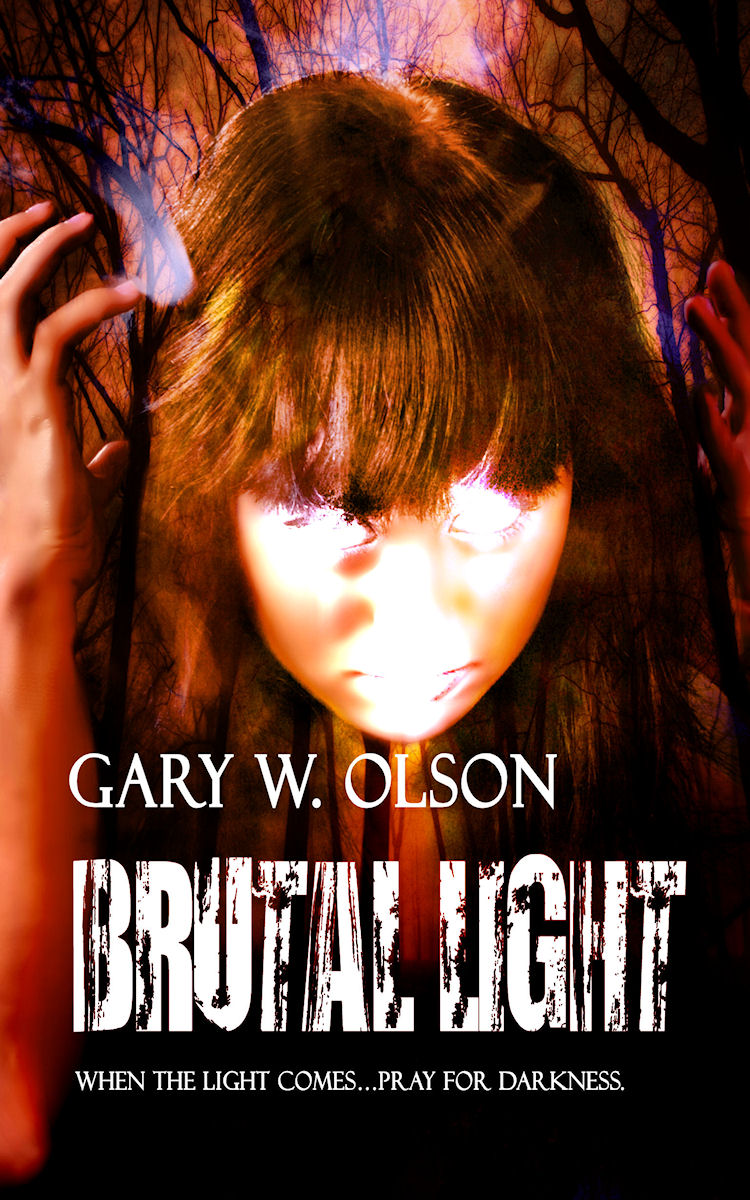 All Kagami Takeda wants is to be left alone, so that no one else can be destroyed by the madness she keeps at bay. Her connection to the Radiance–a merciless and godlike sea of light–has driven her family insane and given her lover strange abilities and terrible visions. But the occult forces that covet her access to the Radiance are relentless in their pursuit. Worse, the Radiance itself has created an enemy who can kill her–a fate that would unleash its ravenous power on a defenseless city…
Rhea Cole is also on the run, after murdering her husband with a power she never knew she had–a power given her by a strange girl with a single touch. Pursued by a grim man unable to dream and a dead soul with a taste for human flesh, she must contend with those who would use her to open the way to the Radiance, and fight a battle that stretches from the streets of Detroit to a forest of terrifying rogue memories.
*
Excerpt from “Brutal Light”:
The light surrounded them, bringing the crushing hum Gordon remembered. His mind screamed with the sound.
He reached into Havelock as Havelock reached into him. At once he was in the forest outside, in the body of a wolf running hard through brush and foliage. Panic beat with the wolf’s heart. Rage coursed through its nerves with each impact of paw against soil. The wolf burst into a clearing and saw a boy’s mutilated body.
The wolf slammed to a halt, and Gordon felt himself thrown as if ejected through the windshield of a crashing car. An image of his body formed without his conscious will, and he flew over the boy. As he crashed into the ground and rolled, he realized he had seen the boy just moments ago, peering through a window. He was almost sure the boy wore the same orange shirt now on the corpse.
Gordon was on his feet in an instant, facing the wolf. But the wolf was gone. Havelock stood in its place, staring down at the boy’s corpse. Horror and guilt surged through the emptiness that was in his expression only a second before. Gordon thought it was like watching him come out of a trance.
Light seethed beyond the trees and stabbed down through the green canopy. Things moved beyond the edge of the clearing, between the trees and the relentless glow. Some were bestial. Some had human shapes. All murmured with a delirious anticipation.
Havelock saw himself as a wolf—that much was clear. The question of why was not clear, and also of no interest. What Gordon wanted to know was why the memory of finding this boy, the memory Gordon triggered with his attack, had been powerful enough to make him drop his guard.
Gordon became conscious that his right hand gripped a handle. He didn’t need to look away to know that it was part of a shovel, or that it was already drenched with blood. He didn’t need to think of why it had come to his hand.
Unlike Havelock, he knew his demons.
Gordon leapt at Havelock and swung the blade of the shovel at his throat.
*
Buy links for “Brutal Light”:
Amazon.com (Kindle edition)
DamnationBooks.com (.mobi, .epub, .lit, .pdf, .pdb)
Links for of all other vendors (continually updated): http://BrutalLight.GaryWOlson.com
Print ISBN (for ordering paperback via bookstore): 978-1-61572-539-7
Digital ISBN: 978-1-61572-538-0
*
Bio for Gary W. Olson:
Gary W. Olson grew up in Michigan and, despite the weather, stuck around. In 1991 he graduated from Central Michigan University and went to work as a software engineer. He loves to read and write stories that transgress the boundaries of science fiction, fantasy, and horror, while examining ideas of identity and its loss in the many forms it can have.
Away from working and writing, Gary enjoys spending time with his wife, their cats, and their mostly reputable family and friends. His website is at http://www.garywolson.com, and features his blog, “A Taste of Strange” (http://www.garywolson.com/blog), as well as links to everyplace else he is on the Internet, such as Twitter (http://twitter.com/gwox) and Facebook (http://www.facebook.com/gary.w.olson.author).


 R.J. Sullivan Fiction